

STREET STYLES TRAINING
WEEKLY DROP-INS
SEPTEMBER - JUNE
Weekly recreational drop-ins that build technique, new skills, freestyle confidence and street styles dance knowledge!
$25 + GST / class or register for full class and pay tuition (see Pricing).
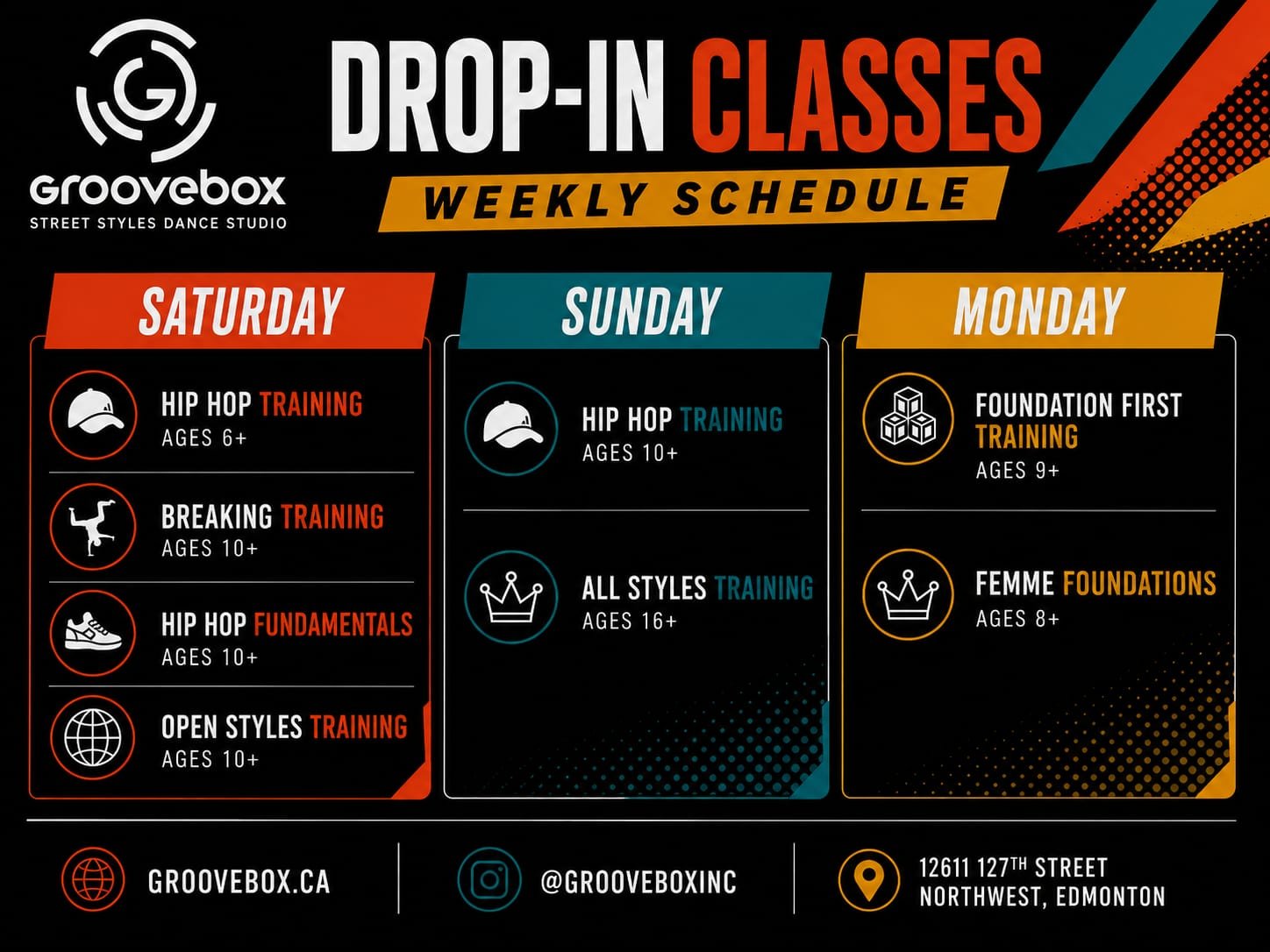
AT GROOVEBOX STUDIO…
we offer the following Street Styles Drop-in classes
Hip Hop Training- ages 6+
Learn the bounce, rock, skate, and roll to develop foundational skills and rhythm with a team.
All Styles Training - ages 18+
An adult all-styles training class. Perfect for adults looking for a fun dance class that will level up their technique and movement vocabulary without the pressure of routines or stage choreography.
Open Styles Training- Ages 10+
This class focuses on a variety of street styles to provide students with more advanced movement concepts and groove. Topics include animation, groove, performance, freestyle, levels and mindset.
Hip Hop Fundamentals Training - Ages 10+
Our new Hip Hop fundamentals training class introduces students to basic steps and grooves in both old-school and new-school Hip Hop. Have fun with friends while listening to amazing music.
Foundation First Training- Ages 9+
Open level, all styles foundation class. Great for all ages and skill levels. It will build stronger technique in street styles like Popping, Animation, Waving, Gliding, Hip Hop and more. Build core strength, conditioning and awareness with a team while leveling up your fundamentals each week.
Breaking- Ages 10+
A dedicated breakdance drop-in class. Come learn the fundamentals of breaking in this open-level class. No experience required. Work at your own pace with guided instruction in top rock, drills, footwork concepts, freezes, power moves, and combinations.
Femme Foundations- ages 8+
This open level class focuses on training and developing skills with a femme feel. It is influenced by Street Jazz, and contemporary and commercial choreography. Street Jazz is a fusion of Jazz and Hip Hop originating in New York.
What are Street Styles?
There are many different styles of street dance, each with its history and culture. Some of the most popular types of street dance styles include hip-hop, breakdance, house dance, locking, and popping.
Hip-Hop
First and foremost, Hip hop is more than music; it’s a cultural movement that incorporates different elements of art and expression. Four foundational elements characterize hip hop culture. The original four main pillars of hip hop include DJing/turntablism, MCing/rapping, B-boying/breaking, and visual/graffiti art. These forms of expression have also developed into further subcultures with lasting legacies.
Hip-hop dance is a type of dance that is performed to hip-hop music or that has developed as a part of hip-hop culture. It includes foundational elements in its movement like the Bounce, Rock, Skate and Roll and include a wide range of street dance styles, primarily breaking, locking, and popping which were created in the 1970s and made popular by dance crews in the United States. Hip-hop first gained popularity in the South Bronx region of New York City in the late 1970s. At this time, many young African American and Latino people were looking for a way to express themselves through movement.
These dancers developed new styles of dancing that incorporated elements from other styles, such as jazz, tap, and breakdance. Hip-hop quickly spread to other parts of the United States and then to countries around the world. In the 1980s, hip-hop dancers began to appear in music videos and movies, which helped to increase its popularity even more. Today, hip-hop is one of the most popular styles of dance and can be seen in many different forms, such as breakdance, popping, and locking.
Breakdance (Breaking or BBoying/BGirling)
BREAKING is a form of street dance that originated in the Bronx in New York City during the 1970s, involves acrobatic movements and a focus on ground work. It became popular within the hip-hop scene and is commonly performed to hip-hop music, though it can also be danced to other musical genres.
The main four types of moves are “toprock”, “downrock”, “power moves”, and “freezes”.
House dance
House dance is a free street and social dance that originated in Chicago in the 1980s in the underground house music scene. This style is known for its unique footwork and body isolations.
“Jacking”, “footwork”, and “lofting” are the fundamental elements of House dance. The House dance at the beginning of its development was hard and sharp, the movements were performed with tense hands and clearly fixed, the body had to be hard, and the tread must be firm. Gradually, the dance movements became more plastic, free, and relaxed. There were soft, springy movements of the legs, a gait pushing off the floor.
Locking
Locking is a funky style of dance that was developed in Los Angeles in the late 1960s. It is characterized by a combination of fast movements and freezing in improvisational positions for a short time, and then continuing the movements at the same speed. Locking is danced to funk or soul. And the performers of this dance are called Lockers. When dancing, the Lockers always try to interact with the audience, smiling or even doing something comical.
Popping
Popping is a style of street dance that was developed in Fresno, California, in the late 1960s. It is characterized by a slow tempo and abrupt and jerky movements called claps. Poppers create the appearance of implausible movements by using isolation techniques. Popping can be performed to any music, but it is most often danced to hip-hop or electronica.
The History and Culture of Street Dance
Street dance has its origins in African American culture. African American vernacular styles such as jazz and tap were some of the first styles of street dance. These styles were later fused with Latin American styles to create hip-hop. In the 1980s, street dance became more mainstream with the rise of hip-hop music and culture. Today, street dance is popular all over the world and is a staple in many different cultures.
While street dancing can be traced back to the late 1800s, it was not until the 1970s that it began to gain popularity in the United States. Street dancing became more mainstream in the 1980s with the rise of hip-hop music and culture. Today, street dance is popular all over the world and is a staple in many different cultures.
Street dance styles have become increasingly popular in recent years, thanks to movies like “Step Up” and television shows like “America’s Best Dance Crew” These films and shows have helped to bring street dance styles to a wider audience and have inspired many people to start dancing.
Conclusion
Street dance is a popular and widespread form of dance. There are many different styles of street dance, each with its own unique history and culture. Now that you know a little more about street dance, why not try it yourself? Start dancing!